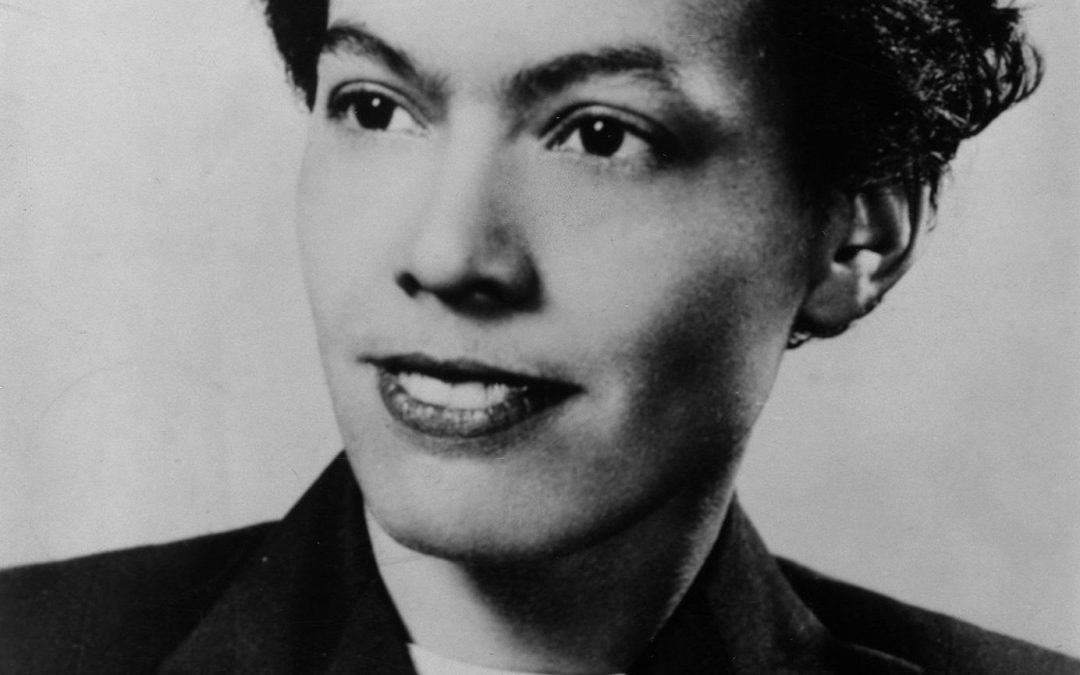
Rev. Dr. Pauli Murray
reflection by Lani Allenbaugh
When I first began reading about Rev. Dr. Pauli Murray (1910-1985), I was struck by how many “firsts” followed their name: the first Black person to earn a JSD degree from Yale Law School, co-founder of the National Organization for Women, & the first Black person perceived as a woman ordained as an Episcopal priest.
Born Anna Paulina Murray in Baltimore and raised by grandparents in Durham, North Carolina, s/he changed their name to “Pauli” and explored their gender identity, seeking but being denied gender-affirming care. Murray thrived academically, graduating high school at 15 and earning a degree in English Literature from Hunter College in 1933.
In 1940, fifteen years before Rosa Parks, Murray was arrested for refusing to move to the back of a segregated bus. At Howard University School of Law- the only woman in the class- Murray experienced both racism and sexism, which s/he called “Jane Crow.” Murray’s law school research helped shape the strategy behind Brown vs. Board of Education. In 1948, Murray produced the States’ Laws on Race and Color, which Thurgood Marshall called “the bible” for civil rights litigators.
Murray’s life reminds us that movements are built long before the spotlight shines. After co-founding NOW in 1966, Murray later stepped away from leadership, feeling it did not address issues of Black and working-class women. In 1977, Murray became the first Black person perceived as a woman ordained as an Episcopal priest, administering their first Eucharist at Chapel Hill, just steps from the university that once denied them entry based on race.
Murray’s witness reflects that faith without justice is incomplete, refusing to separate prayer from protest or theology from public life. S/he stood at the intersection of multiple identities long before “intersectionality” became part of our vocabulary, modeling how justice work must address overlapping systems of oppression.
What I will carry with me is her courage to keep expanding the circle of belonging. She once wrote, “When my brothers try to draw a circle to exclude me, I shall draw a larger circle to include them.” That feels like a word the church still needs today.
Learn More:
Douglas, K. B. (n.d.). Pauli Murray’s Legacy: A Song of Hope and Justice. Urban Missiology International, Inc. Retrieved 02 12, 2026, from https://urbanmissiology.org/faith-social-justice/pauli-murrays-legacy-a-song-of-hope-and-justice/
Pauli Murray. (n.d.). National Women’s History Museum. Retrieved February 12, 2026, from https://www.womenshistory.org/education-resources/biographies/pauli-murray
Who Is Pauli Murray? (n.d.). Pauli Murray Center. Retrieved February 12, 2026, from https://www.paulimurraycenter.com/who-is-pauli