Addie Davis
reflection by Vicki Haydon
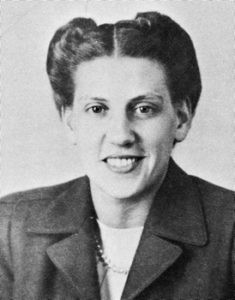
Addie Elizabeth Davis was the first ordained woman minister in Southern Baptist circles. Not only was she the first female ordained Baptist minister, she took on social justice issues of the day. Her sermons addressed racism, unethical business practices and poverty. As a woman in the 1960’s, she had experienced many of these injustices herself.
Addie was born in Covington, Virginia on June 29, 1917. She was born into a Baptist family. Not much is recorded about her childhood. Her parents worked in a paper factory, The family was actively involved in the Covington Baptist Church. Neither of her parents received much formal education. Her father had to leave school at 14 to help support his family after the death of his father. Her father was an extremely hard worker. He saved up enough money to finally open a furniture store. His lack of educational opportunities made him want all three of his children to attend college.
Addie enrolled at Meredith College in Raleigh, North Carolina in the fall of 1938. She majored in psychology and minored in speech. She graduated in 1942, and began serving as the director of education at First Baptist Church, Elkin, North Carolina. Over her four years there, she realized she had not been called to religious education, she had been called to preach.
She applied to, and was accepted by both Duke Divinity School and Yale Divinity School. Her goal of furthering her education to strengthen her resume regarding the pastorate was cut short when her father died in 1944. By the end of the 1940’s, her mother needed help with the furniture store, so Addie returned to Covington. She worked alongside her mother for the next 10 years. In 1960, Addie’s mother retired, and Addie was able to pursue her call to the pastorate.
By this time, Southeastern Baptist Theological Seminary located in Wake Forest, North Carolina had begun allowing women to study for a bachelor of divinity degree (equivalent to the current Master of Divinity degree). In her preaching class she preached several sermons: one of them was entitled “Can We Not Build Bridges of Understanding?” This sermon addressed the subjects listed in the opening paragraph above.
In her History of Christianity course she completed a paper titled “Illustrative Attitudes of the Contemporary Church Toward the Ordination of Women”. In her introduction she wrote “Many people wonder why the question of the ordination of women should arise at all since, obviously, they themselves have not it and see no particular reason why it should be considered. It seems unbelievable to ‘traditional’ thinkers that some denominations have admitted women to the ministry for a number of years, and do not feel that this is a man’s prerogative alone.” Addie was one of six women among the 144 women in the graduating class of May 1963.
During her years in seminar Addie was an active member of Watts Street Baptist Church in Durham. Nearing her graduation from seminary, she asked the congregation to license her to the ministry. She was granted a license to preach on March 13, 1963.
Addie’s search for the pastorate continued for more than a year, and finally after realizing she would not find a Southern Baptist Church open to her leadership, she contacted her college friend, Elizabeth Miller, who worked for the American Baptists. Miller recommended Addie for the pastorate of First Baptist Church, in Readsboro, Vermont, where she had served as pastor previously. Addie interviewed with the pastor search committee and was soon called as pastor. That was in 1964.
Her search to find a church to ordain her was not easy. She contacted several churches in the Raleigh area, and her home church – Covington Baptist Church: they turned her down. As a life-long Southern Baptist, she very much wanted to be ordained by the denomination that had birthed and nurtured her faith and by which she had been affiliated for forty-seven years.
She contacted Watts Street who had ordained her a year earlier. Warren Carr selected a ordination counsel to examine Addie. All the counsel members promised to evaluate her based on her calling and confession. On the day of her examination she was one of two candidates for ordination. The counsel voted to recommend the other candidate, the chaplain to Baptist students at Duke University, despite what they believed to be the young man’s unorthodox belief concerning the virgin birth. Two members of the counsel confessed that they could not recommend a woman.
After a heated discussion, one supportive member asked the two holdouts to explain their apprehension: “Brethren, you leave me confused. In the case of our first candidate, you were quite insistent that he believe that a virgin bore the word. How is it that you are now so adamant that a virgin should not preach the word?” The council ultimately voted unanimously to ordain Addie, with only one abstaining.
Addie was ordained by Watts Street Baptist Church on August 9, 1964. She served as pastor for a number of American Baptist Churches in New England. She died on December 3, 2005.