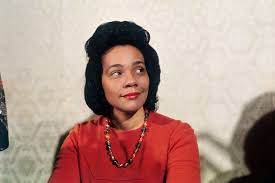
Coretta Scott King (1927-2006)
reflection by Sarah Roberson
In 2001, I sat in the auditorium of Morehouse College. I was a 23 year old political science student from California, sitting in the space where my hero had once spoken. For as long as I can remember, I had studied the life, work, and teachings of Dr. Martin Luther King Jr. In third grade, after hearing the casual tone of racism and asking my parents what it meant, they bought me The Autobiography of Martin Luther King Jr. written for young readers. I opened it on Christmas morning, and inside the front cover was a hand written inscription: “Keep my dream alive. Love, Martin.”
The only logical explanation to my eight year old mind was that Dr. King gave the book to Jesus, Jesus gave it to Santa, and Santa gave it to me.
Fourteen years later, I was sitting in the auditorium of his college waiting to hear his partner speak. The woman he loved. The trained soprano from Boston who had stolen his heart and marched with him for justice. Coretta Scott King.
She was smaller than I expected. Younger somehow than the photographs. She spoke with grace and vigor about bus boycotts, education, widowhood, and raising four children after assassination shattered her world. This was not a black and white image in a textbook. This was the woman who loved him through threats and jailings, who mourned him, and who kept going. The woman who once said, “My story is a freedom song of struggle.”
Coretta was born on April 27, 1927, in Heiberger, Alabama, delivered by her paternal great grandmother Delia Scott, who had been born enslaved. Coretta grew up in Marion, Alabama in a close knit Black community still living under the shadow of Jim Crow. Her father, Obadiah “Obie” Scott, was a truck driver and entrepreneur. He owned land, operated a trucking business, and built a sawmill that gave the family a rare measure of economic independence. Her mother, Bernice McMurry Scott, was a schoolteacher who raised her children to value faith and education.
That independence made her father a target.
White supremacists in an act of terrorism burned down their family home when Coretta was a child. Later, after her father rebuilt and expanded his lumber business, his sawmill was also set on fire and burned to the ground. In her memoir My Life with Martin Luther King, Jr., she wrote, “When I was a child our home was burned down by white racists. We were fortunate that no one was hurt. My father rebuilt.” She explained that her father was considered “too successful” and “too independent” for a Black man in rural Alabama.
But what shaped her most was not the violence. It was her father’s response. “My father never let himself become bitter,” she wrote. “He taught us that you had to stand up for yourself, but always with dignity.” Later she reflected, “I learned early that you could lose everything material and still not lose your spirit.”
The girl who watched her home and her father’s mill burn grew up understanding racial terror not as abstraction, but as lived reality. She learned that resilience was a choice.
She graduated valedictorian from Lincoln Normal School in 1945, played trumpet and piano, sang in the chorus, and enrolled at Antioch College in Ohio. At Antioch, she studied music and became active in the NAACP and civil liberties committees after experiencing discrimination firsthand. She also babysat for the Lithgow family, including a young John Lithgow. I love that detail. The Kings feel sepia toned and distant in history books, and yet she once babysat the guy from 3rd Rock from the Sun.
She later transferred to the New England Conservatory of Music in Boston to pursue voice. It was there she met Martin Luther King Jr. He was enamored immediately. She thought he was a little short. Eventually she fell in love with this brilliant short aspiring pastor, knowing his calling would demand sacrifice.
Her dreams of a full time music career shifted as his pastoral and activist life began to define their shared orbit. They married on June 18, 1953, on the lawn of her mother’s home. She removed the word “obey” from her vows. She led without fanfare, but always by example.
When I think about Coretta’s faith during her marriage to Martin, I do not picture something quiet or ornamental. I picture laughter, music, kitchen table conversations, and lots of prayer. She was raised in the Black Baptist church where faith was the center of community life. Marriage to Martin required her to live that faith under surveillance, through threats, long stretches of single parenting, and constant public scrutiny.
After Martin was assassinated, her faith became even more visible. Widowhood could have pulled her inward, but instead it widened her. She carried his work forward, founded the King Center, and spoke out against poverty, war, racism, and later homophobia. She was the most prominent civil rights leader that advocated for LGBTQ rights.
In 1998, she said, “Homophobia is like racism and anti Semitism and other forms of bigotry in that it seeks to dehumanize a large group of people, to deny their humanity, their dignity and personhood. This sets the stage for further repression and violence that spreads all too easily to victimize the next minority group.”
She was small in stature on the Morehouse stage. She was not loud. But her spirit and words sang of a life lived like Christ. A life that was communal. A life that experienced horror and still chose love. She was delivered by the hands of a woman who had been stolen from her own mother through slavery. She was married to a man who was murdered for standing up for sanitation workers and the poor. And she lived seventy eight years steady and confident.
Her endurance for justice feels sacred and relevant and fully in color.
Learn More:
King, Coretta Scott. My Life with Martin Luther King, Jr., (1969).
King, Coretta Scott. My Life, My Love, My Legacy (2017).
https://www.revolt.tv/article/15-facts-about-the-revolutionary-life-of-coretta-scott-king